
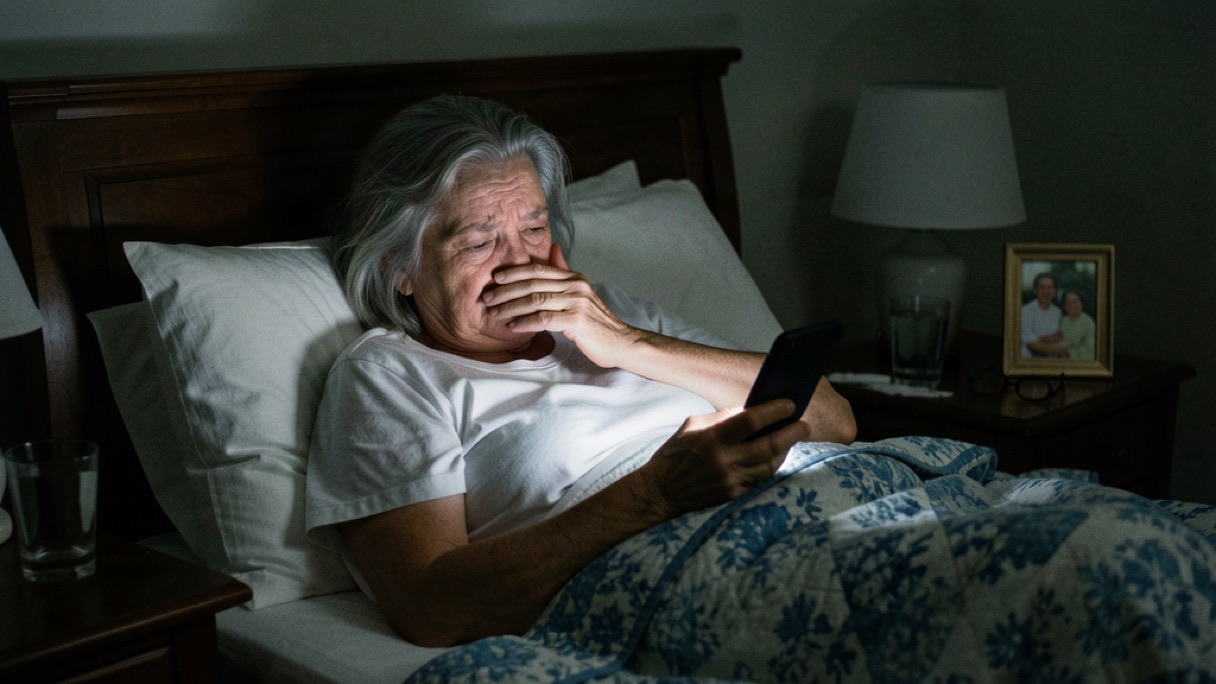
If you have ever lain awake at 3:17 in the morning with the specific clarity of someone whose body has decided the night is over, you already know the arithmetic of it: how tired you are, divided by how much you have tried, multiplied by another day you will have to get through at reduced power.
Summary: you have tried everything on the shelf, and the shelf was never aimed at the level where the problem lives. What follows is what "downstream" means, ten reasons the list keeps failing, what a daily practice at the source actually does — and what it explicitly does not claim.
Read this before you buy another sleep aid.
You have a shelf. Melatonin at three different doses. Magnesium in whatever form was recommended that year. A white noise machine. Blackout curtains that cost more than they should have. A phone app that scores your night out of a hundred and makes you feel worse when the number is low.
You have rules too. No caffeine after two. No screens after ten. Same bedtime even on Saturdays.
And you still wake up.
Here is the part nobody tells you: the shelf is not the problem, and neither is your discipline. Every item on that shelf is aimed at a condition around sleep — light, temperature, timing, chemistry, attention. Not one of them is aimed at the state those conditions act on. That state is upstream of all of them, and it is the only thing that has never been addressed.
01 — Why is the list so long?
Ask anyone who sleeps badly what they have tried and you get a list that sounds like a pharmacy inventory crossed with a wellness podcast.
Melatonin. Magnesium glycinate, then magnesium threonate because someone said it crosses into the brain. Valerian, glycine, L-theanine, ashwagandha, tart cherry. Blue-light glasses, sunrise lamps, weighted blankets, earplugs in three materials. Cold showers, hot baths, breathing patterns with counts on both sides. A sleep tracker on the wrist and a second one under the mattress.
This is not a failure of effort. It may be the most complete attempt at anything a person ever makes. The list is long because the problem is persistent, and it keeps growing because nothing on it has reached the level where the problem actually lives.
02 — What does "downstream" actually mean?
A river is the easiest way to hold it. Stand downstream and you can pull things out of the water all day. Filter it, cool it, add something to it. What you cannot do, from downstream, is change what the river is carrying in the first place.
Sleep works the same way. The night is the water at your feet. What produces the night — the state the body is in when the room goes dark — is upstream.
Every tool you own operates on the water.
This is not an argument that the tools are useless. Melatonin is a real timing signal. Magnesium does something measurable in a deficient body. CBT-I is one of the best-evidenced treatments in all of sleep medicine. The claim is narrower and more uncomfortable: they work on the conditions of sleep, and the conditions of sleep are not where the difficulty usually lives.
| This broadcast | Sleep supplements | Apps and trackers | |
|---|---|---|---|
| What it works on | The field around the body, as described in this article — not a signal in the blood | A signal the body already makes: melatonin, magnesium, an antihistamine | Your behaviour: light, timing, wind-down, tracking |
| What you do | Nothing. One emission a day, at a fixed hour | Swallow a capsule, every night, on schedule | Log it, follow the protocol, adjust |
| Equipment | None | None | Phone, wearable, subscription |
| Time per day | 0 minutes | 2 minutes | 20 to 40 minutes, plus mornings |
| Cost | $9.99 a month, or 33¢ a day | Varies, and it recurs every month | Varies, usually a yearly plan |
| What it does not do | No diagnosis, no treatment, no cure, no mechanism we can measure | Can interact with medication; depends on the dose being right | Does nothing if you stop following it |
Logistics, not claims. This table says what each option asks of you, not what it will do for you.
03 — Why melatonin moves a signal, not a state
Melatonin is not a sedative. It is a message: darkness has arrived, start the night. The pineal gland sends it, the brain reads it, the body arranges itself accordingly.
When you take a capsule you are adding a copy of the message. If the message was missing — late light, a shifted schedule, a body that has stopped reading its own clock — a copy can genuinely help. If the message was arriving fine and something else was wrong, you have added a second alarm clock to a room where the problem was never the time.
Nothing in that capsule knows anything about the state you are in when the signal lands.
Receive daily scalar energy
One transmission a day, at a fixed hour
Six days free, no card. Then $2.99 for the first month.
See the plans →04 — Why magnesium fixes a deficiency, not a night
Magnesium is a mineral your body uses in hundreds of reactions, muscle relaxation among them. If you are deficient, correcting it is medicine, and it can matter more than any sleep ritual.
But the effect is bounded by the deficiency. Once the level is right, more magnesium does not do more. It does not touch the arousal that has nothing to do with minerals — the alertness that arrives at 3am without a cause, the body that will not stand down.

05 — Why the perfect room still does not work
Darkness, quiet, cool air, a mattress that does not hurt. These are not small things. They are the conditions a night needs, and for some people fixing them is the whole answer.
For most people who end up reading an article like this one, the room was fixed years ago. The curtains are up. The phone is face down. The temperature is right. And the hour still arrives.
A perfect room is a stage. It does not write the play.
06 — Why discipline is the most expensive thing you have tried
Sleep hygiene is a list of behaviours, and behaviour is the one thing you have unlimited control over — which is why it is the first place anyone sends you, and why it works for a while.
It works because it lowers the inputs to arousal: less light, less stimulation, less variation. What it cannot do is decide that the arousal should be lower than it is. You can follow every rule perfectly and still be a person whose system does not come down at night — and the cruelty of that is that the failure looks like a character flaw rather than a missing level.
You have not failed at sleep. You have been optimising inputs to a state you were never given a way to reach.
07 — What is a bad night actually costing you?
Here is what a bad night costs, in the only currency that matters, which is not money.
It costs you the first two hours of the morning, when the work that needs a whole brain is supposed to happen. It costs you the decision to cancel something on Thursday because you cannot predict how you will feel by then. It costs you the version of yourself that is patient with the people you love. It costs you the belief that your body is on your side.
Multiply that by the nights per month. Then by the years. That is the real price of a problem you have been managing instead of addressing — and no supplement on the shelf is priced against it, because none of them claims to reach that level.
08 — What does "the source" mean here?
This is where most articles about sleep make a turn into something they cannot support, so let us be exact about the model instead.
In this practice, the body is treated as a field — not a metaphor for "energy" in the vague sense, and not a device you wear. The claim is narrow: there is a state the body is in that is not captured by any single input you can adjust, and that state is what the night is built on. Call it arousal, call it regulation, call it the field. The practice calls it the field.
We cannot measure it. There is no instrument on this site, no number, no chart of your night. What exists is a practice built on that model, running daily for the people on its list, and a deliberate refusal to dress the model up as a measurement.
So when this article says "works at it", it means: this is the level the practice is aimed at. It does not mean we have proven an effect at that level. Anyone who tells you they have, for this, is selling you something else.
09 — What happens during the six days?
No device. No app. No appointment. No headphones, no mat, no pendant.
You give three things — a name, a date of birth, a city — and they go on a fixed list. One transmission a day is sent for that list, at a set hour, whether you are awake, working or asleep. The field stays open after the broadcast, so there is no window you have to catch and no way to miss it by being in a meeting.
It is quiet by design: subtle, silent, below the threshold of anything you would notice. Most people feel nothing during it. That is the normal case, not a failed one.
What you can inspect is smaller and more concrete. Each morning an email arrives with that day's date and the broadcast number — a dated record that the thing you signed up for actually ran. If the email stops, the practice stopped, and you will know before we do.
10 — What this is not
It is not a treatment for insomnia, and it is not a substitute for care. Insomnia has treatments with real evidence behind them — CBT-I first among them — and a doctor is the right person to assess a sleep problem that has been running for months.
It is not a diagnosis of anything. Nobody here will tell you why you wake at 3am, because nobody here can.
It is not a device, a supplement, a frequency generator or a therapy session. There is nothing that arrives in a box.
It is not clinically tested. There are no trials of this practice, no control group, no published endpoint, and we are not going to imply otherwise with a footnote.
And it never asks you to change anything you are already doing. If you take a prescribed medication, you keep taking it exactly as prescribed. If you are in therapy, you stay in therapy. Any version of this that tells you to stop something is not this one.
What people actually report
The accounts below come from the book, published as they were written, with permission and names withheld. They are reader experiences, not product reviews, and they are not evidence of a result — but they are the most honest thing we can put here until someone hands us a story about the broadcast itself.
The problem was not sleep: it was what I believed I was losing. Seven nights with almost no sleep. One night I noticed the sentence I kept repeating — I will miss something when I sleep — and I changed it for: nothing is lost while I sleep. It was not a technique, it was to stop believing that. That night I slept nine hours straight.
I imagined another version of me who had never had the problem. Before sleeping, my chest closed: no air went in, not even a little. Instead of fighting it, I imagined another version of me, in another universe, who had never had that problem. Something clicked in my chest and I breathed deep.
Our policy on stories is published on this site in full: no payment, written permission, no rewriting of quotes, and the indifferent stories printed next to the glowing ones — what we ask and what we do not edit.
What it costs, exactly
Six days free, no card. Then $2.99 for the first month, $9.99 a month after that — 33 cents a day. Or $99 a year, which is $8.25 a month and 27 cents a day. Or $299 once, covering thirty months.
The first payment is refundable for fourteen days. One reply takes you off the list the same day, and the emails stop.
There is no upsell, no coaching call, no supplement to add, and nothing that arrives in a box.
See the plans and how the broadcast works →
Questions worth asking
Is this just placebo?
Partly, and we say so out loud. Expectation is a real, measurable phenomenon, and a practice that asks nothing of you and tells you it is subtle is going to recruit expectation. There are two honest pieces on this site about exactly that — one on the placebo effect in energy healing, one on expectancy in energy medicine — and neither of them pretends the question is settled. If a quieter night arrives and the mechanism is expectation, you still had the quieter night. What we will not do is pretend the question does not exist.
My doctor has never mentioned it.
Your doctor will not mention it, and that is not a conspiracy. Clinical guidelines are built on trials, and there are no trials of this. A practice with no evidence base does not enter a guideline, however many people report sleeping better. You are not being asked to choose between the two. Keep the doctor. Add the broadcast.
I felt nothing. Does that mean it failed?
No. Feeling nothing is the expected outcome, and it is written into the design rather than discovered afterwards. The thing to check is the record, not the sensation: did the dated email arrive every morning, with the number going up? If it did, the practice ran.
Why a fixed hour?
Because a fixed hour is what turns this from a purchase into a practice. Something that happens at a set time every day, that you do not have to remember, is the only version of this that survives a busy week. The field staying open afterwards is the concession to real life: you do not have to be present for it.
What we do not claim
We do not claim this cures, treats, prevents or diagnoses insomnia or any other condition. We do not claim it replaces medication, therapy or medical advice. We do not claim a mechanism we can measure, a trial we have not run, or an outcome we cannot guarantee. We do not claim that because it worked for one person it will work for you.
What we claim is smaller: that everything you have tried for sleep has been aimed at the conditions around the night, that the state those conditions sit on has gone unaddressed, and that there is now a version of this practice you can run for six days at no cost and judge by the only evidence it produces — a dated record and your own nights.
If that sounds like less than you were hoping for, it is. It is also the truth, and it is the reason the trial asks for no card.
This article is for information only and is not medical advice. It does not diagnose, treat, cure or prevent any condition. Persistent sleep problems deserve a doctor's assessment; CBT-I is the best-evidenced first-line treatment for chronic insomnia. Do not stop or change prescribed medication without speaking to the prescriber. Individual experiences vary and nothing here is a promise of a result.