
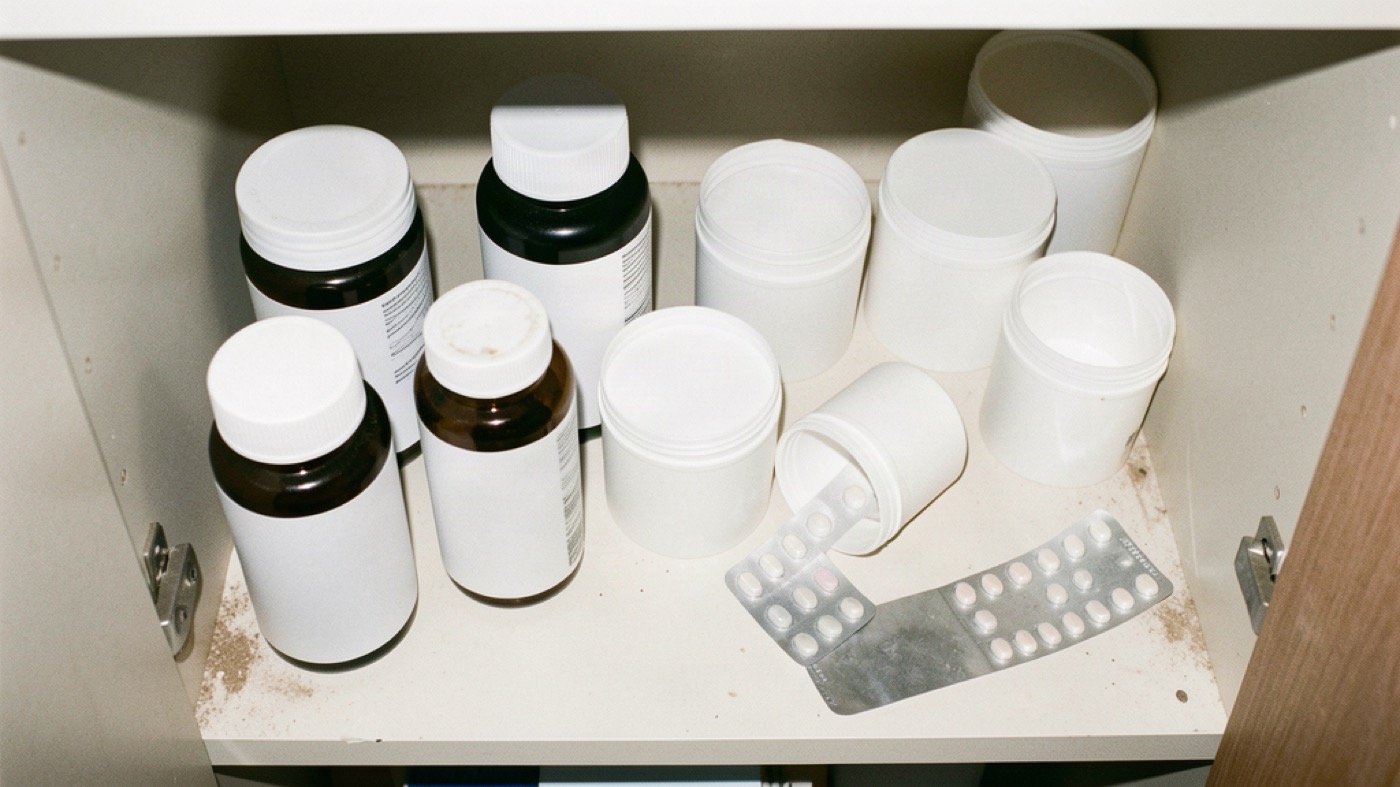
The ritual is small and nobody teaches it to you. At some point in the evening — half past ten, usually — you take a glass down from the cupboard, fill it, and swallow the thing that is going to make the next eight hours possible. You do it without thinking about it. You have done it without thinking about it for years.
Then you get into bed and wait to find out whether tonight is one of the nights it works properly.
Nobody at any appointment has ever asked you the only question that would matter: not what you take, not how much, not how long — but what state you are in when the light goes out.

What the pill actually does
Let us be exact, because the argument only works if it is exact.
A sleeping pill shortens the distance between lying down and being unconscious. It turns a key. For a bereavement, a hospital stay, a week of impossible stress, that key is the difference between functioning and not functioning, and anyone who tells you otherwise has never needed it.
But a key does not build the room. The state you are in when the night begins — the baseline the body is running on — is not something a tablet constructs. It is something the body is already in or is not.
A sleeping pill does not build the state. It lowers the cost of not having one.
That is why the dose creeps. Not because you are weak, and not because the drug stopped being real, but because you are asking one mechanism to compensate for a level it was never designed to touch. The tablet is doing its job. The job was always smaller than the problem.
What gets asked at the appointment
The appointment is fifteen minutes, and it is structured around a set of reasonable questions: how long does it take you to fall asleep, how many times do you wake, are you tired during the day, has anything changed, do you want to try something else.
Those are questions about the night. They are the right questions for a prescription.
What is not asked — because there is no box on the form for it — is what your system is doing at nine in the evening, before anything has started. Whether it is still running at the speed of the day. Whether it has been at that speed since 2019.
So you answer the questions, you get another month, and the thing underneath stays exactly where it was.
Why it is not a discipline problem either
There is a second appointment, the one you have with yourself, and it is worse.
You should go to bed earlier. You should put the phone down. You should not have had that coffee at four. You have a list of shoulds long enough to fill an evening, and every one of them is aimed at the conditions around the night rather than at the state the night is made of.
You have been treating a level problem with behaviour. It is like trying to heat a house by opening the curtains.
The level underneath the prescription
Here is the whole idea, and it fits in three lines.
The body runs on a state. The night is produced from that state. Everything you have bought — the tablets, the magnesium, the curtains, the app — adjusts the circumstances in which the night happens, and none of them addresses the state itself.
So the practice we are describing is deliberately placed one level down: a fixed daily broadcast, aimed at the field rather than the body, with nothing to swallow and nothing to wear.
You send three details — a name, a date of birth, a city — and they go on a fixed list. One broadcast a day is sent for that list at a set hour, and the field stays open afterwards. It is subtle by design. Most people feel nothing at all, and that is the design rather than a failure.
The only thing that arrives is an email each morning with the date and the broadcast number, so the thing you check is whether it ran — not whether you felt something.
What this is not
It is not a reason to stop your medication. It is not a treatment, a therapy, a device or a supplement, and nothing arrives in a box. It has not been clinically tested, and we are not going to pretend a footnote makes it so.
It is also not an argument that you have been foolish for the last three years. The pills were the correct answer to the question you were asked. This is a different question.
What people actually report
The accounts below come from the book, published as written, with permission and names withheld. They are reader experiences, not product reviews, and they are not evidence of a result.
I have taken the same tablet since 2015 and I have never once been asked what I am like at nine o'clock. The first thing I noticed was not sleep. It was that I stopped dreading the hour before bed. The tablet stayed exactly where it was.
What it costs, exactly
Six days free, no card. Then $2.99 for the first month, $9.99 a month after that — 33 cents a day. Or $99 a year, which is $8.25 a month. Or $299 once, covering thirty months.
The first payment is refundable for fourteen days. One reply takes you off the list the same day.
See the plans and how the broadcast works →
Questions worth asking
If I already sleep with a tablet, what would I even notice?
Probably nothing during the six days, and that is the honest answer. The design is deliberately below the threshold of sensation. What changes for most people is the thing they were not measuring: how much of the evening is spent bracing.
Why would a fixed hour matter?
Because a fixed hour is what turns a purchase into a practice. Something that happens at a set time, that you do not have to remember or perform, is the only version of this that survives a bad week.
Is this just placebo?
Partly, and we say so. Expectation is real and it is measurable, and a practice that tells you it is subtle will recruit it. If a quieter evening arrives and expectation is the mechanism, you still had the quieter evening. What we will not do is claim a mechanism we cannot show you.
This article is for information only and is not medical advice. It does not diagnose, treat, cure or prevent any condition. Do not stop, reduce or change a prescribed medication without speaking to the prescriber. Persistent sleep problems deserve a doctor's assessment; CBT-I is the best-evidenced first-line treatment for chronic insomnia. Individual experiences vary and nothing here is a promise of a result.